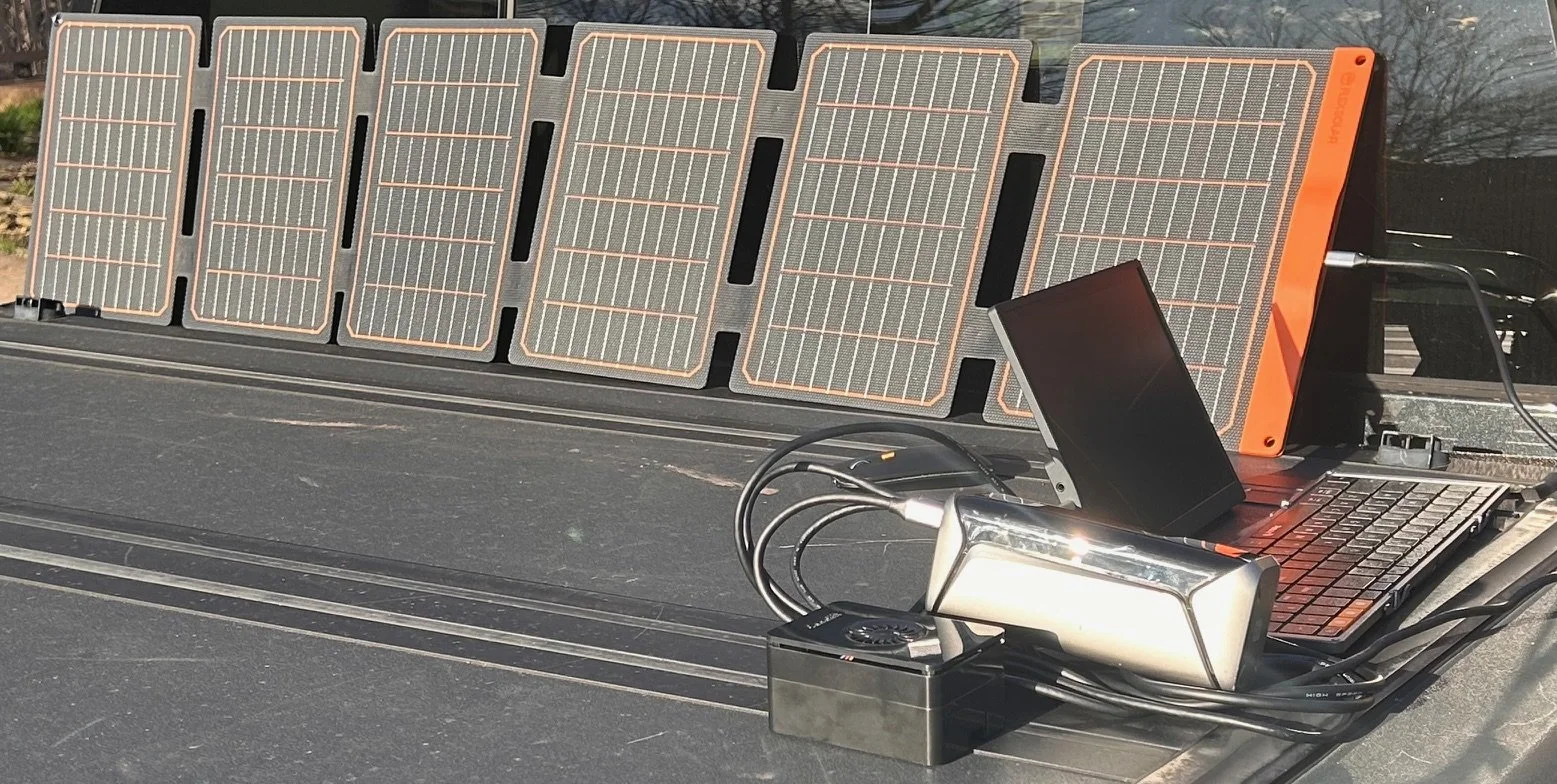
Overmountain Scoured Sentry X (OSS X) Prototype
Background: Advancing the Edge Compute Threshold
The original Overmountain Scoured Sentry established that a fully self-contained, solar-powered artificial intelligence surveillance platform could execute advanced neural network inference at the edge without cloud connectivity, external power infrastructure, or operator intervention. OSS X builds on that work, but with a narrower and more specific research objective: identifying the minimum viable compute substrate capable of executing the BACKWATER pipeline while remaining compliant with Federal Aviation Administration operational requirements.
Our Solution:Sub-Eight-Pound, Energy-Positive Edge Artificial Intelligence
OSS X has a total integrated system mass of 7 lbs 10.19 oz, a 67 percent reduction relative to the original OSS. The ARM-based single-board edge processor at the core of the system was selected as the lowest commercially available compute platform capable of sustaining BACKWATER pipeline execution. Under active inference load it operates within a 5 to 10 watt thermal envelope. The monitor draws 2.8 watts. Total system power consumption during field validation was approximately 5.6 watts.
What makes this result significant is what was happening at the same time. The photovoltaic subsystem was delivering 40 watts of charging current to the onboard energy storage unit throughout the entire evaluation. OSS X was not merely sustaining itself on harvested solar energy. It was generating roughly 7 times more power than the system consumed, actively replenishing energy reserves while running live artificial intelligence inference.
That is a demonstrated state of energy-positive autonomous edge operation, at the minimum viable compute threshold for BACKWATER pipeline execution, in a FAA-compliant form factor.
Component Configuration
Edge processor: 5.57 oz
Keyboard / mouse: 12.98 oz
Battery: 1 lb 8.94 oz
Monitor: 12.24 oz
Cables: 6.21 oz
Solar panel: 2 lbs 8.25 oz
Total: 7 lbs 10.19 oz
Without solar, the system weighs 5 lbs 1.94 OZ
Field Validation: BACKWATER Land Domain Pipeline at Minimum Viable Compute
OSS X successfully executed the BACKWATER advanced neural network pipeline against a synthetic dataset of 10,000 devices, spanning 4,093,399 individual records across communication, geospatial, application usage, and network topology modalities. Balanced classification accuracy was 99.9 percent. The model produced a single misclassification across the full evaluation set, one operative incorrectly classified as commander. Zero civilian false positives were recorded. Area under the receiver operating characteristic curve was 1.0 across all five role categories.
All inference ran locally on the edge processor. No network connectivity, no cloud dependency, no reachback of any kind. The photovoltaic subsystem held steady at 40 watts of charging input for the duration, while total system draw sat at approximately 5.6 watts.
It should be noted that OSS X operates on a substantially reduced throughput compute substrate relative to the proprietary hardware used in the original OSS. That was the point. For mission profiles where FAA compliance, system mass, and portability are the binding constraints and extended pipeline duration is acceptable, OSS X is a validated and deployable configuration at the minimum viable compute threshold for BACKWATER execution.
Power Consumption: From High-Performance Workstation to Edge-Class Compute
Prior iterations of the BACKWATER pipeline were executed on a high-performance AI workstation rated at 240 watts peak system power, with observed active inference draw of approximately 140 watts. OSS X ran the identical pipeline at approximately 5.6 watts total system draw. That is a reduction in operational power consumption of roughly 96 percent.
The more notable finding is the context in which that reduction was achieved. OSS X ran the BACKWATER pipeline in a net energy-positive state on solar power alone, with no external power source.
Why This Matters
For Special Operations and Intelligence Communities:
Validated identification of the lowest compute substrate capable of executing the full BACKWATER insurgent network classification pipeline
Sub-eight-pound forward deployment in environments where the original OSS footprint is logistically or tactically prohibitive
Energy-positive solar operation confirmed under field conditions, not laboratory simulation, with 40 watts of photovoltaic input sustaining approximately 5.6 watts of system draw
Complete air-gap security posture with all inference performed on-device and zero external data transmission
For Humanitarian and Civil Applications:
Ultra-portable autonomous deployment for disaster response, remote population monitoring, and infrastructure-denied environments where even 23 pounds presents a logistical barrier
Solar self-sufficiency validated under real operating conditions, across a dual-channel power architecture sustaining active artificial intelligence inference and active battery recharge simultaneously
Identical air-gap security posture and edge artificial intelligence processing capability as the original OSS, in a configuration that can be carried, cached, or concealed in austere field conditions
Synthetic Data Only. All 4,093,399 records are synthetic. Operational validation with real-world data is required before any deployment consideration. Use our contact form to get in touch for additional information.